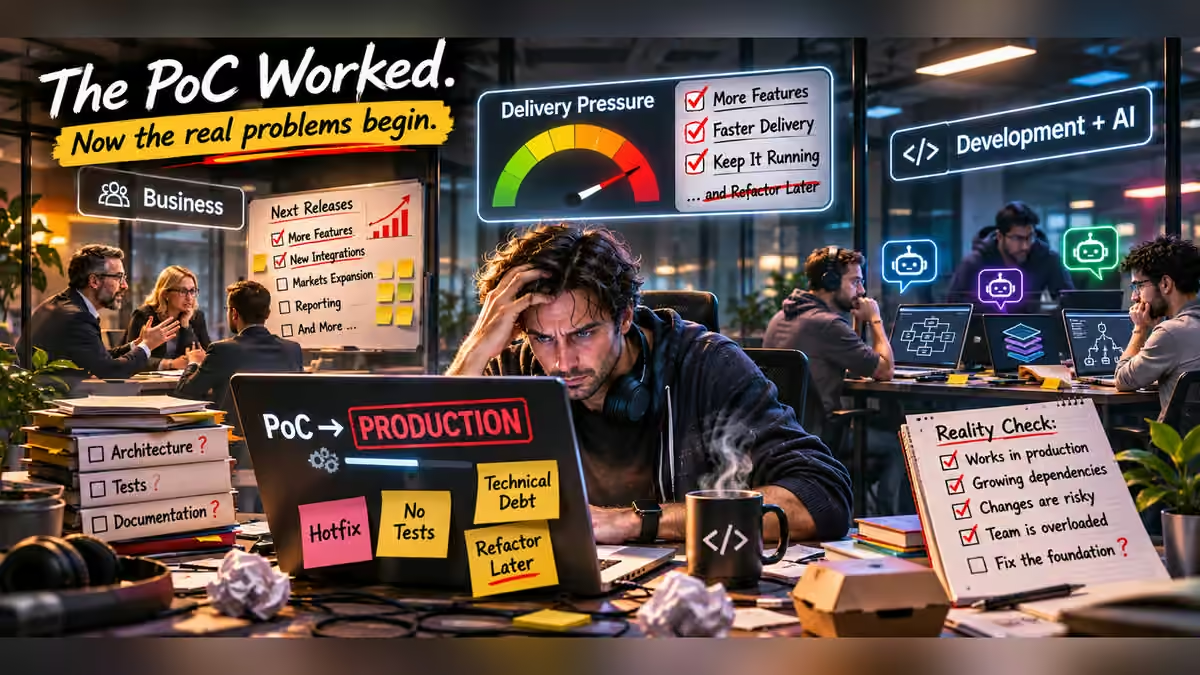
The PoC works. The team celebrates, the business wants more features, and the experiment quietly becomes production. But the shortcuts that made it fast to build are now part of a system people depend on.
Add more developers, AI agents, new integrations, and deadlines, and the problems don't disappear. They simply become more expensive to solve. The difficult engineering decisions often begin after the successful demo.
1. The Beginning: What Are We Actually Building?
Before discussing implementation, it's worth distinguishing between a PoC, a prototype, and an MVP. A PoC validates feasibility, a prototype explores or demonstrates a solution, and an MVP delivers a minimal usable product. Their purposes can overlap, but the terms aren't interchangeable. More importantly, none of them automatically describes the engineering quality or operational readiness of the implementation.
When starting a PoC, engineers often face a choice between writing the smallest possible implementation, sometimes in a single file, and establishing a minimal engineering foundation. The latter might include a sensible project structure, clear responsibilities, basic tests, and lightweight CI. Both approaches are valid, and neither excludes testing. The real question is whether the implementation is genuinely disposable or might become the foundation of something larger.
This is where experience and understanding of requirements matter. A minimal foundation isn't an excuse to build an enterprise architecture for a two-week experiment. It's about recognizing which decisions can safely wait and which might become expensive to reverse.
I remember a project from roughly ten years ago, during the early days of widespread cloud adoption. An application was planned for AWS, with authentication built around Google OAuth. The implementation was almost complete when an additional requirement involving Microsoft Azure surfaced. It had been discussed at the business level but hadn't made its way into the requirements used by the engineering team.
The problem wasn't simply adding another API call. The team hadn't validated how the additional integration would fit into the existing solution, and even the DevOps engineers didn't have a ready answer. A requirement that should have influenced early technical decisions had effectively disappeared between stakeholders.
Now consider what happens when a similar omission survives until after launch. The application gains features, other services begin depending on it, and the original implementation becomes established infrastructure. Introducing the forgotten integration might now require changes across authentication code, application architecture, deployment configuration, and cloud infrastructure. The same missing requirement becomes significantly more expensive to address.
A better directory structure wouldn't have prevented this. Verifying critical integrations, documenting assumptions, and clarifying the experiment's boundaries might have.
AI changes the cost of the initial implementation, but not this responsibility. Generating a project structure, tests, and configuration takes much less effort than it once did. Sometimes coding agents introduce additional abstractions without being asked. Yet twenty directories can contain just as many questionable decisions as one file.
The challenge remains choosing the smallest foundation appropriate for the risks we actually understand.
2. The Middle: More Developers, Less Progress?
The PoC succeeds, and the business sees an opportunity. The roadmap expands, deadlines become aggressive, and adding developers looks like the obvious way to accelerate delivery. Unfortunately, software development doesn't scale linearly with headcount, especially when the project isn't prepared for a larger team.
Imagine nine developers joining a project originally built by one or two engineers. They bring different backgrounds, programming languages, architectural preferences, and development practices. Without documented decisions, clear responsibilities, or agreed engineering standards, each starts interpreting the system in their own way. One introduces new abstractions, another extends existing logic, and a third solves a similar problem using a completely different approach. Individually, their solutions may work, but together they create inconsistencies, duplicated responsibilities, and additional maintenance costs.
Now consider the same situation with AI-assisted development. Each of those nine developers may bring their own coding agent, model, global instructions, and configuration. In a sense, we've gone from nine different perspectives influencing the codebase to eighteen. The agents aren't additional team members, but their suggestions influence technical decisions, sometimes introducing abstractions or implementation patterns nobody explicitly requested.
A shared project-level foundation can reduce these differences. An AGENTS.md file or equivalent agent instructions, documentation in docs/, ADRs, and automated checks in CI can establish common expectations for both developers and their tools. They won't guarantee identical solutions, nor should they. Individual experience, personal configurations, and model behavior still matter, but at least everyone starts from the same engineering constraints.
AI hasn't created the coordination problem. It has increased the speed at which inconsistent decisions can be implemented.
Adding developers can increase delivery capacity, but only when the project provides enough shared context and clear boundaries for them to work together. Otherwise, we may simply accelerate the production of code that the team will spend the next few months trying to reconcile.
3. The End That Never Happens
This is the problem I've encountered most often. A PoC passes an A/B test, starts serving real traffic, or demonstrates enough value that the business decides to keep using it. Features are added, dependencies grow, and the experiment gradually becomes production infrastructure. Yet nobody formally decides that the PoC is over or what engineering work its new role requires.
The original shortcuts remain, while the system continues evolving around them. Developers recognize architectural problems and propose improvements, but the response is familiar: "Let's finish this feature first. We'll refactor it afterward." Then comes another feature, followed by another promise. Months later, the backlog is larger and the same problems remain.
New features usually have a clearer business value than refactoring, so architectural improvements struggle to compete for development capacity. In outsourcing, the problem can be even harder when technical improvements require additional customer approval or budget. Meanwhile, workarounds accumulate, exceptions require more exceptions, and changes that should be straightforward become unpredictable.
Testing illustrates how the problem can be reinforced from both sides.
I've heard the business argument: "Why do we need tests? Are our developers writing bad code?" I've also heard the opposite argument from a developer: "We change the code too often. Tests would be too complicated and time-consuming right now." In the latter case, the PoC/MVP had already been running in production for roughly six months.
Both arguments miss the purpose of testing. Tests aren't a punishment for poor developers, and frequent changes aren't automatically a reason to avoid them. Tests tied too closely to implementation details can certainly become a maintenance burden. But checks around critical, observable behavior help us change implementation without blindly risking existing functionality.
When such protection is missing, architectural improvements become harder to justify and more dangerous to perform. Before changing the system, engineers may first need to reconstruct and verify behavior that was never properly documented. Meanwhile, every additional feature expands the amount of behavior that must be preserved.
Responsibility Without Unlimited Time
Engineering teams are responsible for the quality of their work. They should identify risks, establish appropriate safeguards, and explain the consequences of shortcuts. Technical debt isn't always imposed by management; sometimes engineers themselves continue accepting decisions that stopped making sense months earlier.
But responsibility doesn't create additional time. When nearly all development capacity is committed to new features, substantial architectural improvements cannot simply happen in parallel without affecting delivery. That doesn't justify unlimited refactoring budgets either. The necessary work needs to be identified, estimated, prioritized, and agreed upon.
Time, scope, and quality are competing constraints, particularly when team capacity is fixed. If the business wants more functionality sooner, the consequences of that choice must be explicit. Repeatedly postponing essential engineering work isn't a sustainable compromise; it's accumulating an obligation without deciding when to pay it.
There's also a human cost. Engineers who repeatedly raise the same problems and receive the same promises eventually lose confidence that anything will change. Some stop proposing improvements; others leave the project. The organization then risks losing both experienced developers and the undocumented knowledge that kept the system running.
Agree on the Boundaries Before They Disappear
A PoC doesn't need extensive documentation, but it needs a clear purpose and boundaries. The team should record what is being validated, which requirements and integrations matter, what assumptions and shortcuts have been accepted, and how success will be evaluated. Just as importantly, it should define what happens after that success.
Does the implementation get discarded, rebuilt, or promoted into a maintained product? If it moves into production, which tests, architectural changes, operational safeguards, and documentation are required? Who owns that decision, and how will the work be prioritized?
These answers won't prevent every unexpected requirement or eliminate technical debt. They do, however, make the transition a deliberate engineering and business decision rather than an accidental consequence of a successful experiment.
For systems already caught in this situation, the answer isn't necessarily a rewrite. Identify the most dangerous dependencies, establish tests around critical behavior, document the existing constraints, and agree on a limited improvement plan with clear priorities. Progress can be incremental, but it needs to be real rather than another promise about what happens after the next feature.
Final Thought
A successful PoC should trigger a decision: discard it, rebuild it, or deliberately accept responsibility for maintaining it as a production system.
Otherwise, temporary shortcuts become permanent dependencies, and the company keeps paying for decisions nobody revisited.
Sometimes the most expensive part of a PoC isn't building it. It's maintaining the decisions nobody revisited after it worked.